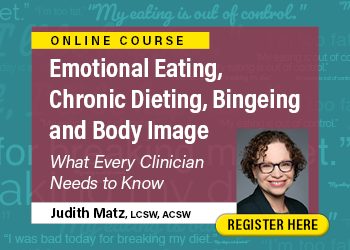
These modules will help you master the skills to:
- Identify issues related to food, weight, and body image from your first session
- Understand why clients get stuck in the diet-binge cycle and how to finally break it
- Engage, support, and help your clients repair their dysfunctional relationship with food and their bodies—no willpower necessary!
- Help your clients respond to well-meaning—yet harmful—weight loss “compliments”
- Discover your own hidden biases and ingrained cultural stereotypes about weight that could negatively impact your clients' treatment
- Share simple mindfulness practices that can help reduce emotional eating
- Determine if individual or group therapy would best serve your clients
- Help clients develop a healthy framework that ends out-of-control eating without being beholden to fad diets and self-punishment
- And SO much more!
You'll also receive access to essential tools such as:
- Hunger Fullness Scale: Helps to identify the physical cues of hunger and satiation
- Hunger Matching List: Identifies the kinds of tastes and textures you're craving so you can choose the foods that will satisfy your needs in that moment
- Patient assessment form: Determine if your clients have a Binge Eating Disorder (BED) or emotional overeating problem
- AIM Protocol: This handy acronym aids clients in eating intuitively so they can nourish their body and soul
- Writing prompts to help you and your clients truly understand their complex relationship to food, dieting, and body image
- Self-assessments to help you uncover and transform any subconscious/unrealized biases you may have toward higher-weight people—including your clients—so you can better serve them
- A paradigm-shifting framework that takes the focus off weight loss and shifts it to developing a healthy relationship with food. When this happens, weight loss is often a side effect, but it's not the goal.